
There’s always something to do in London.
Like go to the Capital Link shipping conference.
Because shipping is a top ranked YWR sector and everyone wants to know whether to take profits, stick with it or buy more.
Here are my notes and observations.

The Energy Security Panel:
96% of the world population relies of imported energy. Geopolitics is pushing this energy farther away.
70% of global trade goes through maritime chokepoints.
The world has huge exposure to maritime security.
Current situation started in 2022. The Russia-Ukraine War and sanctions on Russia increased energy ton-miles by 7%. Russian energy had to go to India and Europe had to import gas from US.
The whole shipping picture keeps evolving and creating large arbitrage opportunities which means traders will pay a lot for ships. At the beginning of the Iran War there was a huge trade to sell naphtha in the Gulf of America to Asia so ships realigned for this trade. Then there was a big trade to bring diesel to Australia. Everytime, ships need to reposition. Now you have Asian markets trying to diversify away from the Gulf. All of this locks up ships on long-term routes.
Governments may need to get into shipping, the same way they have been getting into critical metals and supply chains. ADNOC purchased older tankers and is crewing them with military personnel in order to get their energy products out of the Persian Gulf using the US Navy shuttle service.
The world has done a good job of managing through the situation so far. We came into the crisis with elevated oil stocks, but these have been worked down. Where there are still elevated inventories of crude and refined products is within the Persian Gulf which are trapped. From here the oil price is likely to react a lot more.
The tanker market could stay expensive for the medium term. The Iran conflict could go on for years. There is no making peace between Iran and Israel. Even if the war is resolved peacefully in the near-term there will be a restocking trade. Inventories will need to be rebuilt and countries will structurally want to carry more inventory. All this will require tankers.
Customers want to secure long-term contracts, but it’s really hard to know the right price. The fleet is aging quickly and not many ships are available. Oil companies want to make sure they have shipping companies to move their product. Some customers are willing to lock in 7 year tenders for ships being delivered in 2030.
‘World is chaotic but shipping is booming. Everyone is enjoying it.’
Huge lead times on new supply. No new shipyard capacity. Orders now will be delivered in 2030.
Longer-term the current disruption will accelerate investment into small modular nuclear reactors and electrification of the grid.
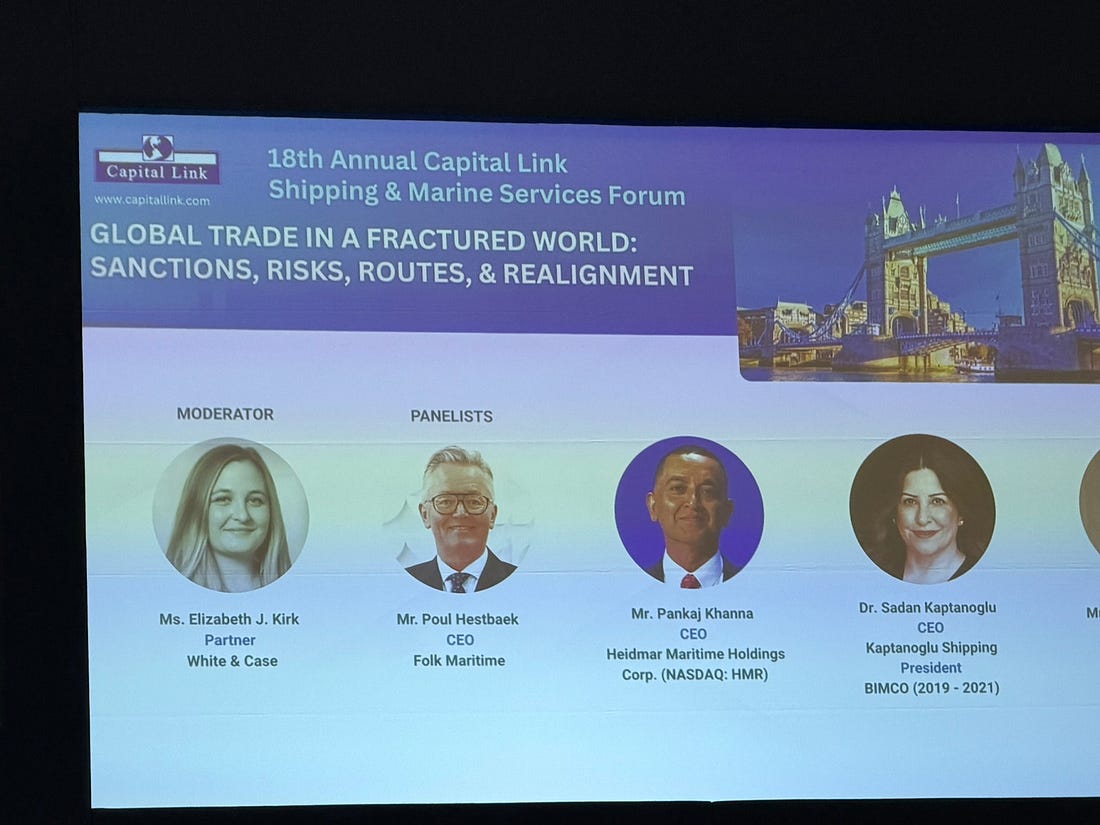
Global Trade in a Fractured World Panel:
Panama Canal has drought problems.
Ships are laid up in Istanbul and don’t want to go into the Black Sea.
Ships don’t want to go into the Persian Gulf.
Now they don’t want to go into the Red Sea.
Somalia is still a problem but not talked about as much.
Security is a non-stop problem.
Blocking maritime chokepoints and attacking commercial ships is the new normal. Sanctions + terrorism + ship attacks are here to stay. It’s a new age of Piracy.
Complying with all the sanctions and compliance is also challenging.
Making lots of money, but hard to enjoy it.
Globalisation is over. New trend is near-shoring and friend-shoring. China is building factories in Egypt to get goods closer to the European market. Saudi Arabia is buying solar panels from India instead of China.
The post WW2 Era is over. We are in an era of strong men (Trump, Putin, Modi). The global south is full of strong men. It makes everything more volatile for the shipping industry. ‘We are like a ping pong ball bouncing between everyone.’
For Russia and the Middle East being able to deliver energy and service their customers is an existential problem. Customers have to have confidence Russia and Saudi can deliver the energy and right now that is in doubt.
It used to be a 6,000km route to send oil to to Asia, now using the Egypt Sidi Kerir route around Africa it is a 12,000 km route.
Japan imported 90% of its crude from Middle East, but is trying to diversify this exposure. It will mean sourcing crude from farther away (like Brazil) even if it is more expensive.
4th generation Turkish shipowner is diversifying her business into ship building for the Turkish Navy.
Tanker order books are 30% of the fleet. But offsetting this there has been no scrapping of tankers. The Shadow Fleet will also have to be scrapped. So tanker bull market might last longer than people expect.
Seafarers are under stress, but actually recruitment interest at academies in Philippines and India is high. Pay for top officers has tripled. Many are making so much money they will be able to retire early.
The Black Swan event from here is if problems kick off between Taiwan and China. 78% of the ship order book is in China. If those ships can’t be delivered it will be another shock for the industry.
YWR Observation: No one had a strong view on how long the bull market would last. The word ‘uncertainty’ reiterated over and over again. Also, lots of discussion about things politicians and the world ‘should do’ to restore freedom of navigation. General mood is that the good times may last a bit longer than expected, but will eventually normalise. Either peace will come to Middle East, or new ship deliveries would lower rates.
MEPC Reality Check (Net Zero Panel):
IMO is trying to create rules to force shipowners to reduce emissions but there has been a lot of pushback. Sounds like IMO is pausing without saying that they are pausing. “Assuring shipping industry that everything is still under discussion.”
“IMO needs to acknowledge that the alternative fuels just aren’t there yet.”
Maersk was an early mover and bought some methanol ships in 2022, but sounds like they are not totally sold on methanol and still considering other fuels like ammonia, even nuclear.
Really hard for ship owners to order ships with 20 year lives when there is uncertainty around fuel regulations. Alternative fuels cost 2-3x conventional fuels.
Dual fuel ships are another solution.
“What are we regulating? Can buy a low emission engine, but then burn just as much carbon if you drive the ship faster (15 knots instead of 11).”
“Emissions can be reduced in other ways besides the engine fuel. Better maintenance, propellers, carbon capture.”
“Need to make sure there is fuel availability in all the ports not just ‘some ports’ or in ‘green corridors’.”
YWR Observation: This uncertainty about IMO engine regulations is another positive. It dials down new ship ordering.
Financing Shipping Panel:
Currently not much demand from banks for ship financing.
Ship owners aren’t really doing anything. They are watching the money flow in. There are ship owners with 20 ships fully paid off and $500mn in the bank.
A lot of 2nd hand tonnage is delevered.
There aren’t really any new banks in the ship financing industry. It’s the Greek banks and the German banks. The new player is the alternative funds. The Greek banks have been very active.
Container rates have been surprisingly resilient. The consolidation in container shipping appears to be working.
One banker thinks the top 5 container lines are colluding to keep rates high.
Same banker thinks this might also be happening in tanker market. There aren’t really that many ships on spot. He figures if you and a few friends can control 200 tankers you can control the spot market.

Where will the money flow next panel:
Private credit fund that was very active in shipping around 2016 is struggling to find opportunities now. Back then you were financing ships at 60% of replacement value, now you are financing ships at 95% of replacement value. The outlook is highly dependent on continued geopolitical risk. Equity part of capital structure is the most sensitive to geopolitical risk. Debt is less so. The order books are picking up. In 2-3 years we could be having a very different discussion.
From JPM Asset Management: If you are a Greek shipping family watching the cash come in, and have always been in shipping, then you make sure all your ships have been paid off and then maybe reinvest some of the cash in new ships. Greek family offices are also taking the opportunity of the cash bonanza to diversify out of shipping. But if you are an institutional investor trying to underwrite new deals today on a deal by deal basis it is difficult. Owners of ships have a gusher of cash coming at them and if you want to take that gusher of cash away from them you really have to pay up.
Moving a VLCC from ME to Asia used to be $2mn but is now $70mn. Do it twice and you have paid for the ship.
Western ship owners are hamstrung by compliance concerns. It is a disadvantage to being compliant. You can make a lot of money right now on certain non-compliant routes, but there can be some challenges when selling a ship depending on what is has done during this period.
ADNOC trying to keep their business balanced and reinvesting tanker profits into terminals, and specialist segments.
Can buy ships with ‘28-29 delivery and 5 year charters to guarantee ‘some’ return.
A Bulk Ship owner regrets he didn’t get more into containers and tankers. Liner business is highly monopolised. Top 10 went from 30% market share to 85% share. Top 1 controls 25% share. Other markets (bulk) are not consolidated.“Container market prices are managed. VLCC’s will be the same way.”
Infrastructure funds are coming into lots of previously specialised areas like LNG.
Question going forward will governments be more involved in shipping? Energy has become like this and the US wants to have a container line.
Those are my notes.
But what is the conclusion?
How do we make money?
Here’s my conclusion and also the global factor model rankings for the shipping stocks.
I came away from the conference bullish.
I think the sector goes higher.
Especially tankers and containers.
The only new information I hadn’t appreciated was the uncertainty around ship engine emissions and how that could be hindering enthusiasm to buy new ships.
But mostly it was listening to everyone talk and try to rationalise everything.
#1 Nobody could articulate the bull case.
Nobody had a multi-year bullish view. Or, maybe they did but were keeping it to themselves.
I heard all the usual concerns about the order book and cyclicality of shipping. Shipping rates should come down (eventually). Reversion to the mean type stuff.
But I didn’t hear any conviction around where the world was going.
Ship owners could see routes were fractured and longer. Owners can see geopolitical problems are popping up with increasing regularity. But there was no strong view on why this is happening or whether it would continue. They can see attacking shipping is a new form a terrorism. They also had no view on whether the Iran War would end next month, next year or next decade.
No one stood up and said ‘You have no idea how much higher this is going. This is going to last 10 years and get worse. You should take every $ you are earning and buy as many ships as you can, as fast as you can and keep them all on spot.”
OK, maybe that’s an exaggeration and only a crazy person like me would say that, but you know what I mean.
That lack of conviction was bullish.
#2 Finance Bro’s struggling with geopolitics.
I liked listening to the private credit guy.
He was massive in shipping post-GFC when he could show on his spreadsheet he was lending against depressed ship values. A mean-reversion trade.
But now that the bull case had become ‘geopolitical’ and required imagination he had no conviction and was looking elsewhere for opportunities.
That’s good. I like that the Wharton MBA’s throw up their hands whenever something gets geopolitical. It means they won’t come and ruin the party with billions in excess capital.
It also means public shipping companies run by unimaginative boards of directors will also unlikely to authorise a huge ship ordering programs. There is no ‘logical’ reason to justify paying the highest price ever to buy a new ship, other than if you are replacing an old one.
The opposite of ‘geopolitical uncertainty’ is a neatly presented McKinsey ‘Long term theme’ where all the dots make sense. That’s when it sounds great, but is actually terrible because the supply response is assured.
So finance bros not bullish was also positive.
#3 Investors and operators missing the magnitude of the trend.
People are worried ‘the order books are full’.
But what if order books need to be 50% bigger?
Tariffs, near shoring, diversifying suppliers, the growth of India as a trading partner, congestion in the Panama Canal, rerouting around the Suez Canal. It all increases trade route complexity.
More nodes in the network.
I have a friend who imports wood flooring from China to Canada. To get around the tariffs his Chinese suppliers relocated as a group to Mexico. Now think about that from a shipping perspective. Previously, a container ship with flooring went from China to Vancouver then back again. 2 nodes. Now a ship has to go from China to Mexico; then later a ship from Mexico to Vancouver. 3 nodes. Plus, imagine that supplier in China also started shipping some flooring to India 1/month because there is a new customer there. 4 nodes.
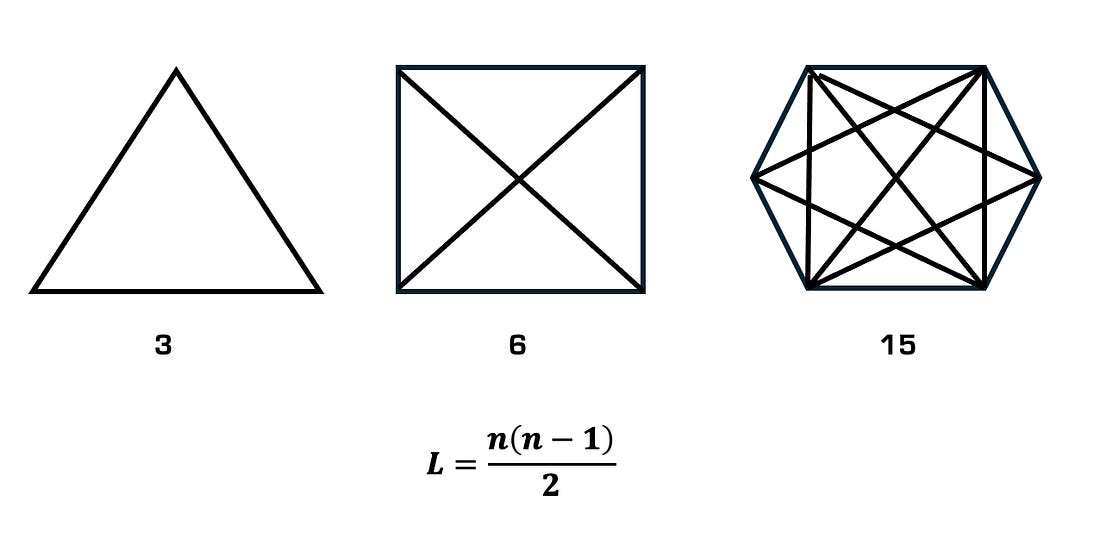
You can connect every point in a 3 sided triangle to another with 3 shipping routes. If the number of vertices increases by one (a square) it requires 6 shipping routes to connect every point. If the vertices increase to 6 (a hexagon) the number of routes needdd to connect every point is 15. It’s a non-linear increase in shipping routes.
Say there are 30 shipping nodes in the world (just as an example) but with changing trade patterns because of tariffs, the growth of the Global South, and maritime disruptions there are now 40 nodes; a 30% increase. The number of connecting routes between the nodes goes from 435 to 780. + 79%!!
Growth in new shipping routes is non-linear as the nodes increase.
And that is what everyone is missing.
They see the trend, they see the growth in dots, but they miss the magnitude.
They can’t imagine that demand is going to overwhelm the order book and shipping rates will be higher for longer.
Years later, when it is clear, and stock prices are much higher, investors will think in terms of nodes and explain to each other why shipping rates never went down.
Market manipulation is underestimated.
Another thing which stuck out. The repeated mentions that container shipping is highly consolidated and rates are managed by the big players. Because that is not what is priced into container shipping stocks. The assumption is that container shipping is one of the worst segments of the market. Container shipping is a feast or famine commodity with too much capacity. The common sense wisdom from the shipping experts is you want to be in specialised segments instead. Also the comment that it wouldn’t be hard to manage spot tanker rates, and it might already be happening, also stuck out.
What I’m doing.
I own Frontline. I think I’ll keep reinvesting the dividends back into more Frontline.
COSCO Holdings also looks good.
The conference also increased my bullishness on owning a shipyard; Kawasaki Heavy (5 Silicon Valley Start-Ups for the Price of 1).
Shipping Global Factor Model Rankings
Below are the latest shipping global factor scores.

Have a good rest of the week.
Erik