


Marc!
Thank you for your message (Part 1).
I enjoyed our coffee on the Bahnhofstrasse!
I keep thinking of your UBS building renovation metaphor. It’s catchy!
I also keep thinking of your observation that the US government increasingly resembles CCP economic policy in that it now picks industries, and takes stakes in companies (Intel). That view gets more accurate by the day. The government’s overt involvement in the Nvidia CEO role is another example. As you say the structure of the building is changing.
It made me want to search for more examples of where the market structure is shifting.
But maybe this is where our views start to diverge.
I came around to thinking about the metaphor in a different way. Yes, the UBS building is being renovated, but in the end it is still a building. We can gut the interior, change the walls, change the paint, but it still follows the laws of physics. It’s still a building. It hasn’t changed into a spaceship.
And the markets haven’t either.
Which got me thinking of how to respond to your message.
And I guess I’d start by suggesting the reason you may be struggling to see a new, different future, and the AI can’t either… is because the future is more of the same.
Let me explain.
‘The Multi-Polar World’
I am in a weird situation; an American from Montana living in the UK/Europe. My friends here are all British or European. Plus some South Africans. In any work or social setting I am always the only American. Especially, the only conservative one. And if I want to have friends I have to keep my mouth shut. So mostly I sit quietly and nod whenever anyone tells me their political views about anything.
And an opinion I hear often from friends from Canada, or India, or France, or wherever, is that I (as the American) don’t truly appreciate how the world view towards the US has shifted. They (whichever country there are from) used to love the US, but now going forward the relationship will be purely transactional, and this will be end up being negative for the US. If this friend is in finance, which they usually are, this view is extended to global asset allocation to suggest it is best to reduce exposure to US stocks, because obviously it will be bad for US companies if they are not loved anymore. The future opportunity will be in international markets.
And it will be a new ‘multi-polar’ world.
If I understood correctly, this is ‘geopolitical re-ordering’ you see playing out; including the likelihood this is 1999 all over again for US tech stocks.
After owning large cap US tech stocks for many years, and doing very well, you sold your tech positions earlier this year because this correction has much more to go.
Well done.
Can I first share a quick story as context for where I think we go next?
It’s something I saw investing in Africa.
Kenya and M-Pesa
In the early 2000’s Vodacom (a mobile phone operator) noticed people were actively transferring airtime minutes around Kenya. The activity seemed strange until they figured out airtime minutes were being transferred person to person by text messages as a form of electronic currency. Seeing an opportunity, Safaricom, Vodacom’s Kenyan subsidiary, developed a mobile payment system called M-Pesa to solve this need.
But operating a payment system was new ground for Safaricom and verged on offering financial services… which needed to be approved by the Central Bank of Kenya (CBK). The CBK wasn’t sure whether to approve this new product. It looked useful, but might have unintended consequences on the banking system in the future. Maybe a telco shouldn’t be allowed to do this.
They hemmed and they hawed…. but in the end in 2007 the CBK issued a ‘Letter of no Objection’, which meant ‘ We’re not saying you can do it, but we’re not saying you can’t.’ African for ‘yes’.
Which was all Vodacom needed to hear. And the rest was history.
19 years later M-Pesa has 41 million subscribers, transacts $320 billion/year and is the dominant financial platform in Kenya with an ecosystem of payments, savings products and loans. Other telecos, such as MTN and Airtel, copied M-Pesa and mobile money has spread across Africa. Being the birthplace of M-Pesa Nairobi is now a fintech hub for Africa. When you visit Nairobi there are numerous start-ups which provide financing for consumers, small business and equipment over the M-pesa platform.
But today’s explosive growth in mobile financial services across Africa and the tech start-up scene in Nairobi all link back to the CBK decision in 2007.
That decisions was a fork in the road.
It was scary, but the CBK chose ‘yes’ to a new technology. And that made all the difference.
That decision in 2007 changed the future of Kenya. The ramifications would play out for the next 19 years. It made Kenya the mobile fintech leader it is today.
What does this have to do with US tech stocks and the multi-polar world?
Europe and the AI fork in the Road
Like with M-Pesa in 2007 we have a fantastic, scary new technology; AI. And we see how each country embraces it. Or doesn’t. The US is all in pushing hard to lead in every aspect; chips, frontier models, datacenters, even datacenters in space. Europe on the other hand (and the UK to some extent) is trying to figure out what should be the new regulations, plus repeatedly butting heads with (or fining) the leading companies in this space (US tech co’s).
This is the fork in the road as I see it.
You either get with the program, embrace AI and the hardware, and position your country to be a winner somehow, or you go the way of the Dodo bird.
Europe is choosing the Dodo bird road and the ramifications of this will hammer it for years. Hammer it in terms of growth, incomes, job opportunities, debt crises and unrest. Many EM countries will have the same challenges. Challenges creating jobs and opportunities for their youth because the growth will increasingly be in high-end tech industries. Industries where their political leadership spends energy combatting the leading companies in the space rather than courting them.
This is a long way of saying I see it as the opposite.
We consider Europe, Canada and the US to be economically similar today. But they aren’t really. US GDP per Capita has been pulling away since 2014 and is at this point quite divergent. I see it anecdotally when I visit friends back home. The wealth level is much higher than Europe. But if I ever mention this it at dinner parties back in London it always turns into a big disagreement and everyone saying that I had only seen the top 1%. They don’t want to acknowledge what is happening because it is upsetting.
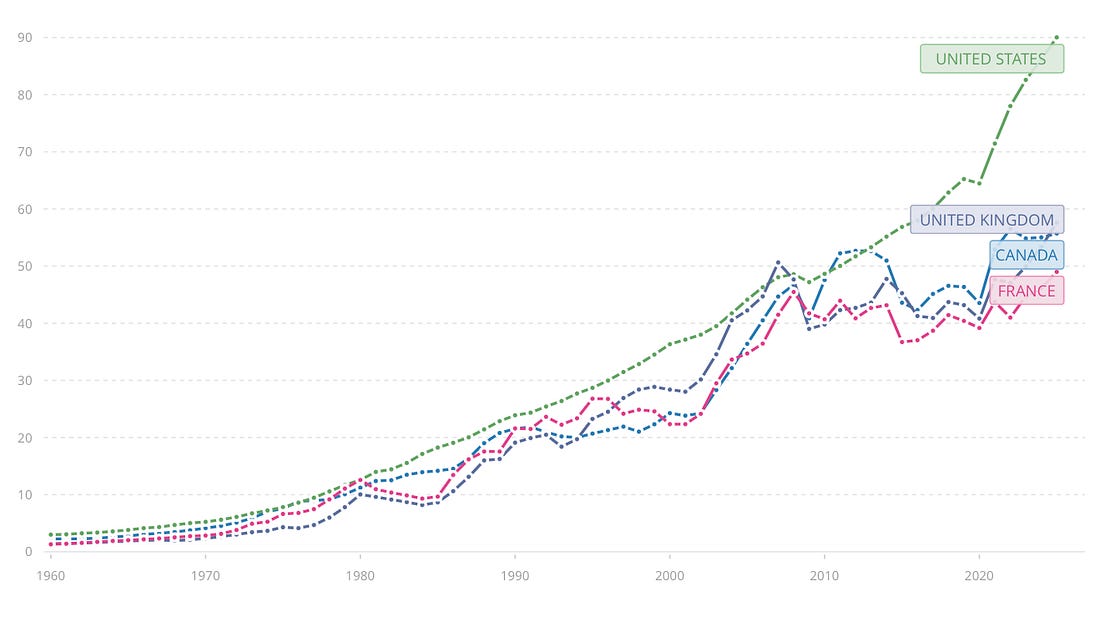
Yes, at a collective level there is global pushback against the US and this seems like it must be bad. But then take it down to the country level. Everyone is mad at the US. OK. But who is the alternative? Who is leading? Who is doing something special?
Singapore, Japan, South Korea, Vietnam, Israel and China are doing well.
Saudi and the UAE are trying.
Then after that it is a lot of sour grapes (I’m sorry if there are some great examples I forgot to mention).
The one country out front leading the world in game changing technology is the US.
And the differences are going to compound. Think of the top students from ETH Zurich. Where will they want to work? If they are good, and love what they do they will want to launch rockets or build robots. They will want to work for SpaceX in Texas.
There will be brain drain in Europe. The builders and dreamers will go to the US where there are opportunities and funding while Europe ossifies. I say Europe, but it will happen to many other countries too. I’m thinking of Canada and Australia.
If I was the president of a country I would be 24/7 schmoozing and offering tax breaks to get SpaceX and Nvidia to invest in my country. Then I would suck all the know-how I could from them (nicely) and build my own Taiwan style tech ecosystem.
Switzerland should totally be doing this.
But no country is feting Elon Musk and figuring out how to get him to build the next Terrafab or rocket launch center in their country. Instead they vilify him and other wealthy tech entrepreneurs.
Yes, the US has many problems. Everyone does.
But on a relative basis I think it pulls away.
Now my view on US Tech
‘Your Heart and Your Brain’
It’s logical to think we must be due for a new era of sector leadership. How can the same companies continue to be the best performers?
I’m not sure whether US tech stocks will continue to be the best performing stocks, but the business model appears to be stronger than ever.
I’ve always thought the corporate trend of ‘moving to the cloud’ was dangerous. Companies were outsourcing a key operational technology to an oligopoly of service providers. Yes companies outsource lots of things, but outsourcing cloud services is not the same as outsourcing janitorial services. Compute and storage are core to running the business. Yet, each company proudly issues press releases about how they are ‘moving to the cloud’ like it is some success story. Really, they are conceding huge gains to AWS, Azure and GCP. These are the core technologies which enable the firm to operate each day. They are outsourcing their heart.
It seemed fine though. The common sense view is it makes sense for each company to specialise in its USP and not worry about how to run servers.
Except it gets worse with AI and it’s why Oracle is pushing so hard to get into the datacenter business too.
If cloud services are the heart, AI is the brain.
In the future every company across the world will not be able to think, breathe or move without their centrally provided cloud services and AI. Sorry, their US provided cloud services.
This is an amazing level of lock-in and companies don’t seem to notice it is happening.
AWS, Azure, GCP and OCI will own your company. Own your corporate circulatory system and your brain.
This is why I find myself thinking the opposite on US tech.
I don’t think there is some new multi-polar world where US tech loses its way. Or, I don’t see it yet.
Instead I see the opposite. I see US tech companies establishing a level of global lock-in which we have never seen before in the history of business. Companies of the future will be locked into US tech for everything.
You said you sold your tech stocks earlier this year. That was well done.
I don’t know.. but maybe after this sell off is it a great chance to buy them back?
I’m sorry if this email was long and took a different view on everything. When I write I tend to be more outspoken than when I am in person. I apologise.
It could also be I’m just slower to see what you are seeing.
Hopefully, we get together in Zurich for another coffee again soon.
Regards
Erik