
In a land of investors with no view.
The one eyed CIO with imagination is king.
I say that because I’m kind of amazed.
I’ve participated in two PM/HNWI/FO best ideas conferences in the last two weeks and listened to over 40 investment professionals stand up and share their best investment ideas on stocks, FX, commodities, economics, technology and macro trends. Both events were fun, with great people, great dinners, and lots of creative ideas.
The ideas were great. But I was also interested in the meta game.
What are a wide sampling of investment experts comfortable pitching. And what do they not want to pitch.
I imagined each of them at some point prior to the event sitting all alone at home thinking of what idea they would present to their peers. Because I had to do that too.
What would sound smart? What would sound stupid? Where did they have conviction? Where would they be able to answer questions intelligently?
Will people agree with the idea?
Or, will I look stupid?
The first conference I attended was quite macro with lots of ideas around being long volatility (interest rates and FX), long gold miners, long UK, long EM, long Brazil, long Venezuela, and shorting the S&P.
The second group was more futuristic and hyper focused on AI. Although it was not a tech conference the best ideas were bullish memory, bullish compute, advanced manufacturing and space. Like group 1, group 2 was also bullish on gold.
All sensible and smart. Don’t get me wrong.
But I couldn’t help noticing the two big things nobody at either conference wanted to pitch. Including me.
One of them is the most important variable in the world.
An obvious thing with the power to derail all other trades.
The elephant in the room.
The emerging energy crisis.
‘Too Geopolitical’
I want to share one more anecdote, because I think it explains why investors have such a difficult time taking a view on the Price of Energy. Even if the Price of Energy is the most important input to economic activity.
I was at a shipping conference in London listening to a private credit analyst talk about his experiences lending to tanker companies. He said it had been easy back in 2013-2016 to lend to tanker companies when the ships traded at 60% of NAV. But currently, everything was ‘too geopolitical’. He didn’t have a view here and wasn’t playing. He would wait 2-3 years for the cycle to turn down again. Not that shipping companies need his money, but the comment was insightful. The sensible MBA graduate was confident to commit tens or hundreds of millions of dollars to a spreadsheet ‘return to the mean’ type trade, but the analysis and conviction broke down completely when it came to analysing political conflict.
What would the IRGC do? What would Trump do?
He had no idea.
Or, just as importantly, I’d say he had no view he was willing to pitch to an investment committee back in Manhattan. No way. Too difficult. There is no Excel spreadsheet or chart which tells you what happens next. We have left the world of spreadsheets and are in the world of religion, history, egos, human nature and game theory. No way he was going to stand up in a boardroom and explain how they were betting hundreds of millions based on his hunch of how a highly religious military might react to a head strong US president who appears irrational and how long shipping rates might stay high. Instead, he conceded that it was all ‘too geopolitical’. Like that’s something we can just choose to ignore.
The Energy Crisis issue is wrapped up in politics so the conversations very quickly get political and uncomfortable. I know because I’ve had them. It’s more pleasant to talk about AI.
Except, maybe we need to get uncomfortable.
In the future when we look back on this time with 20/20 hindsight, will we say the Middle East Energy Crisis was THE most important event which disrupted every other thing and determined everything about asset class performance through that period? Will we say, yes AI was super important over the long-term, but for several years the energy crisis disrupted everything?
Is understanding the unfolding Energy Crisis today the same as realising the significance of the housing bubble back in 2007 and how it would ripple through the financial sector and change the world?
The Frog in Boiling Water.
Guys. I know the Iran-US conflict seems impossible to know and we would prefer to make calls on Memory and Brazil or whatever… but what is happening in the Gulf is freaking massive.
Do you remember back to when we used to fuss about OPEC meetings and whether they would cut 100k or 200k barrels?
That is so insignificant compared to what is going on now.
Iran is blockaded with 2 mn barrels/day offline. 2 million barrels! That in itself if huge. And it’s not an immediate problem, but day by day there is damage to the fields which will take time and work to repair.
Then Qatar; the biggest LNG exporter in the world at 20% of global supply, is blocked in and can’t get its LNG ships out.
Then Saudi Arabia, the second largest oil exporter in the world is getting its arms pulled apart on both sides. The East West Pipeline is blown up, their refineries are getting attacked and their tankers can only get out of the SOM intermittently. What if Saudi gets completely disabled?
Yes, oil and oil products are getting out through trucks, pipelines, and off again on again through the SOH, but we are probably still losing around 6 million bpd of supply which is 6% of global oil supply and maybe 20% of global LNG.
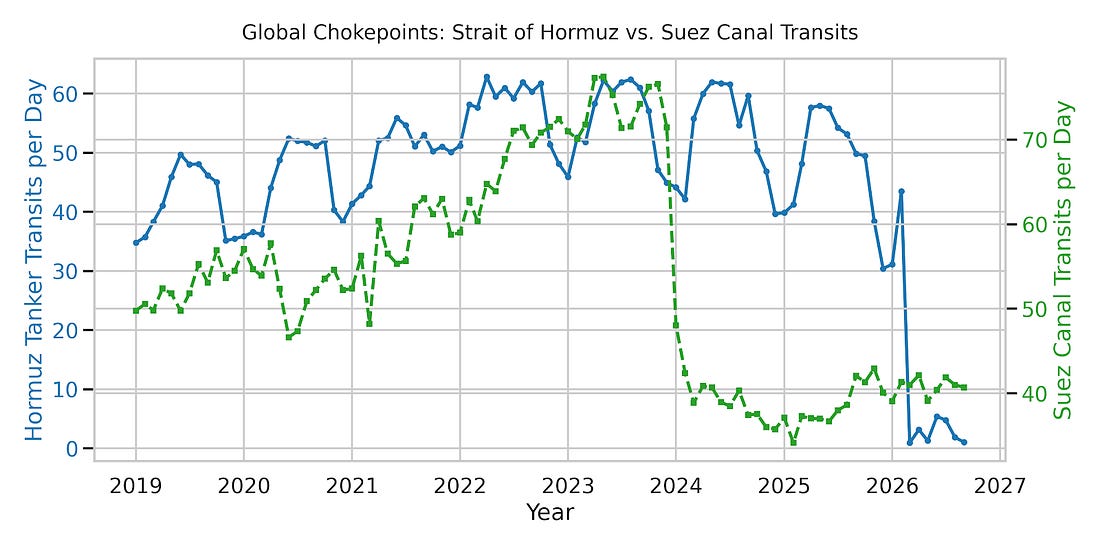
But it’s not just the energy effects. This conflict has killed traffic through 2 of the most important shipping chokepoints. We forget about it but the Suez Canal is one of the great shortcuts of the world, and traffic there is down 50%. Ships from Asia to Europe are diverting thousands of extra miles down the coast of Africa, around the Cape of Good Hope and back up to Africa, adding time and expense to everything.
The Energy Crisis is not confined to the Middle East either. Russian oil has been sanctioned on and off again since the Ukraine War in 2022. Then you have Ukrainian drones have been taking apart Russian refining capacity forcing it to import diesel from India and Turkey. And like with Iran, there are the gradual, slow burn effects to future oil production when investment is sanctioned.
Also looming over the horizon is the effect this conflict will have on fertiliser and food prices if it continues.
Governments have been trying to minimise the shock, but it’s been going on longer than everyone expected and the effects are starting ripple through the economy.
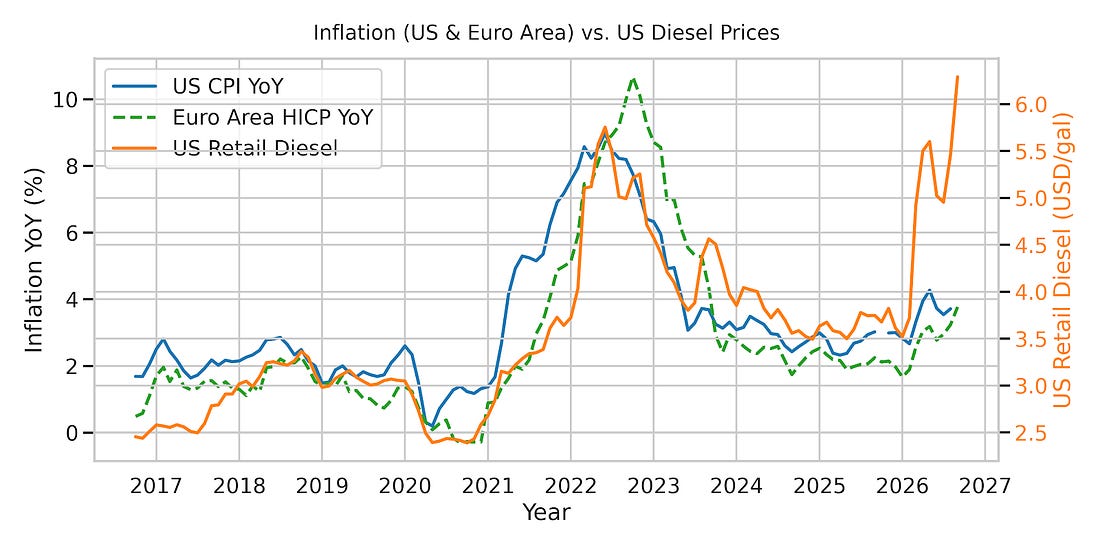
Diesel prices are through the roof.
And like in 2022 broader inflation measures are rising.
Long-term interest rates are also moving higher.
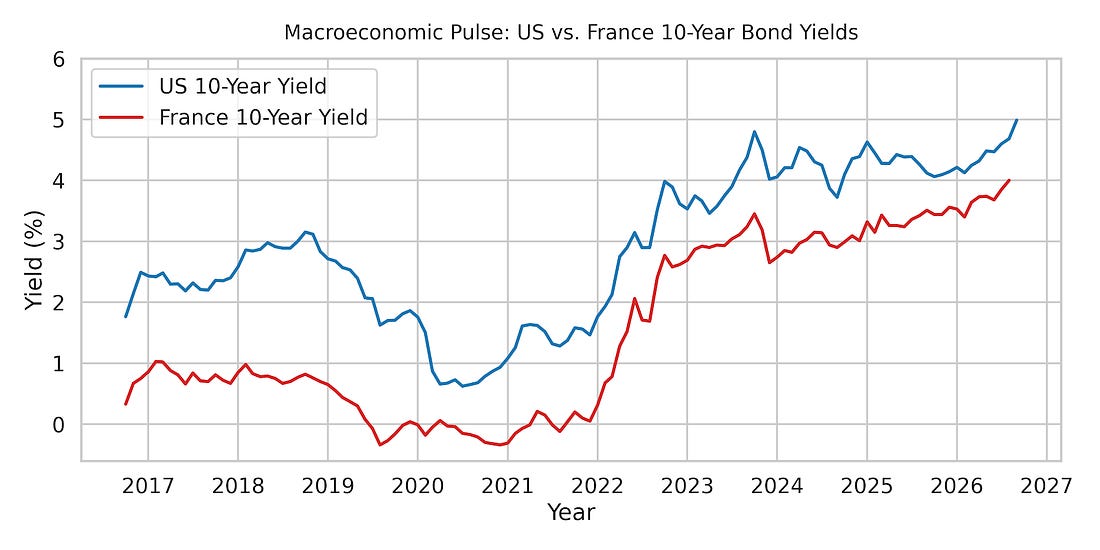
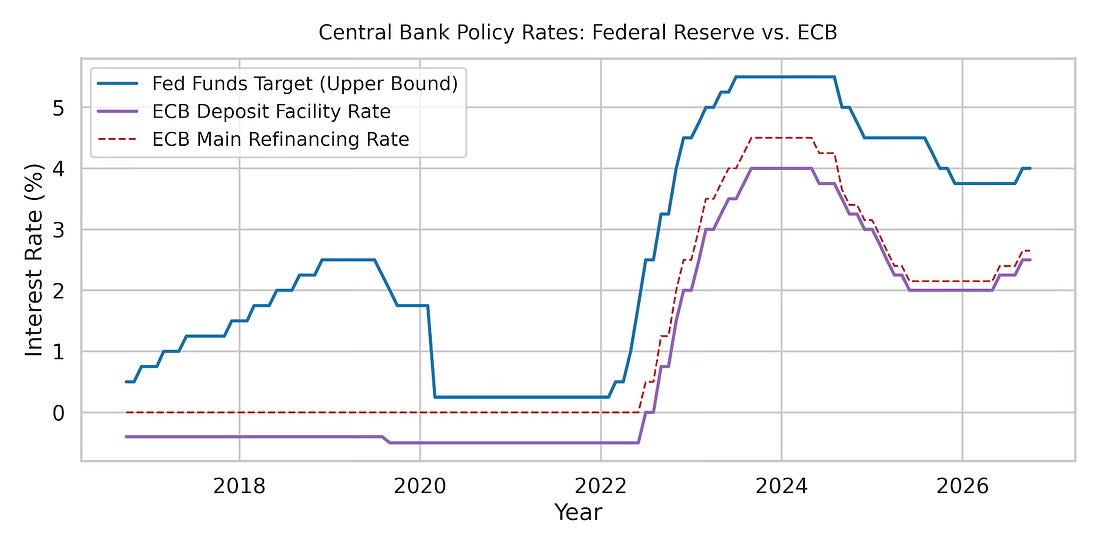
The Federal Reserve and ECB, which thought they would be cutting rates, have had to reverse course and start raising the policy rate.
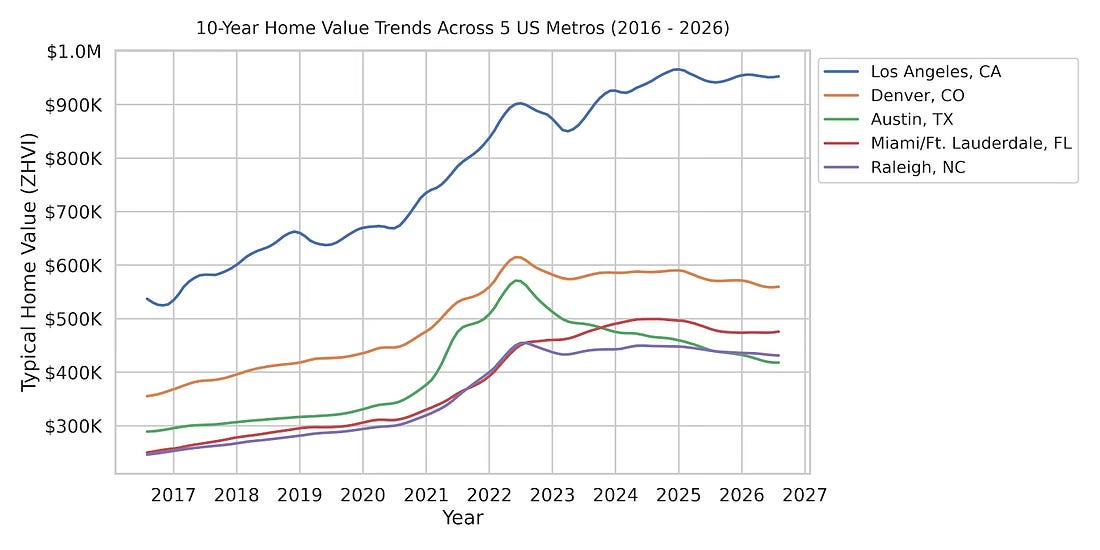
US house prices have been stable so far, but there are signs of weakness as mortgage rates keep moving higher.
Stresses from the Energy Crisis are building.
But like a frog in boiling water nobody wants to panic because who knows, the US-Iran War could be resolved anytime. Nobody wants to be the idiot who panicked and went overweight energy stocks the day before the peace deal.
Irreconcilable Differences
The Iran War has been off again on again since February.
There have been talks and agreements.
There have been times of relative calm.
These fluctuations give us hope the whole problem could go away quickly.
But really this conflict has been decades in the making and there are irreconcilable differences between the parties.
The US does not trust with a nuclear bomb a military dictatorship who for decades has been burning American flags, bombing embassies and chanting death to America. Sorry. No way.
On the other side the IRGC knows the US and Israel want regime change no matter what, and no matter what agreement is signed. They know their only real defence is a nuclear weapon. They want to be untouchable like North Korea.
And it gets worse.
If getting the US, Israel and the IRGC to sit down at a table and potentially iron out their differences wasn’t hard enough, now we have a side fight breaking out between the Houthis and the Saudis. A side fight which may, or may not drag in Pakistan and Turkey.
Yes, there are attempts at talks between everyone, but the escalating missile strikes on cities, airports, ships and political leaders make it hard to put Humpty Dumpty together again.
How could it get resolved?
A consistent view I hear is that the IRGC is an immovable object fighting for its life and will never give up. The IRGC will never step down and can’t be overthrown from within. The US doesn’t want to put boots on the ground and the Iranian protestors are unarmed and don’t feel like charging the machine gun nest over and over again.
There’s always a chance the IRGC dissolves from within and transitions to a more moderate government which the US and Isreal accept, and we get peace. And maybe this happens. Like the fall of the Berlin Wall. But I also reluctantly accept that the IRGC, like an old African dictator, can be good at ruthlessly hanging on to power.
Which leads to the conclusion I usually hear that the only way conflict in the Middle East stops is if the US just goes away, or signs an agreement giving Iran what it wants (control of the SOM and development of nuclear weapons). Because, you know, ‘the US has lost already anyways.
One possibility is that Trump loses the midterms and a new Congress enacts the War Powers Act, which forces the US military to disengage. This requires the Republicans to lose both the House and the Senate.
The War Powers Act might be easier said than done though. The wording of War Powers Act legislation would be tricky in this situation. What exactly would it say? There isn’t a clear war. Would it say the US Navy can’t enforce sanctions on Iranian oil by blockading Iranian tankers outside the SOH? Would it say the US Navy can’t protect freedom of navigation in the SOH? There would have to be clear language which both the House and Senate could agree upon and they never seem to agree on anything.
Historically it has been a tricky piece of legislation. Presidents have notified Congress of US military engagement as stipulated by the War Powers Act, but the act has never forced the removal of the US military from a conflict. Altogether, it might be wishful thinking that Trump loses both the House and Senate and then Congress passes legislation which forces the US military to leave the Persian Gulf.
Some would argue Trump might support the process and actually be relieved to capitulate. He could say his hands were tied and get out of this mess. Possibly.
Then on the other hand is the theory that to some extent conflict in the Middle East is good for the US and US energy dominance. Maybe Trump likes the status quo. It’s relatively stable. No US ships are getting attacked. No sailors are dying. Meanwhile, he and Bessent quietly choke Iran to death. Inconsistency of Middle East energy also keeps China on the back foot.
We can go round and round on what Trump thinks, but it gets more complicated than Trump and the IRGC. We also have the Israelis, Houthis and Saudis. The Israelis will fight the IRGC to the end. They remember everything and will not be done until the IRGC is gone. And I don’t know how you put the Saudi-Houthi fight back in a bottle. The Houthi-Saudi conflict could shake Saudi to its very foundations, which would be a whole new chapter in the future history books.
Then one other thing worth mentioning which thankfully hasn’t happened yet. Turkey and Israel are not happy with each other and have come close to blows in Syria.
I used to play ice hockey in high school. When it had been a particularly rough game and fights broke out the referees could handle maybe 1-2 fights on the ice at any one time. But if it got to three fights at the same time things would get out of control and sometimes ended in a bench clearing brawl. We are in that 1-2 fight inflection zone now. More than 2 fights and it gets exponentially harder to solve.
Messina, Sparta and the Three Hundred Year War.
The first conference I told you about was in Greece. It was lots of fun and one of our side excursions, when we weren’t talking about FX vol, was a tour of the local Greek ruins. Our guide, a local Greek school teacher, walked us around the ruins while casually explaining the various wars which had ravaged the temples. She explained how the cities of Messina and Sparta had fought for centuries. As in “They fought between the 5th and 8th century BC”.
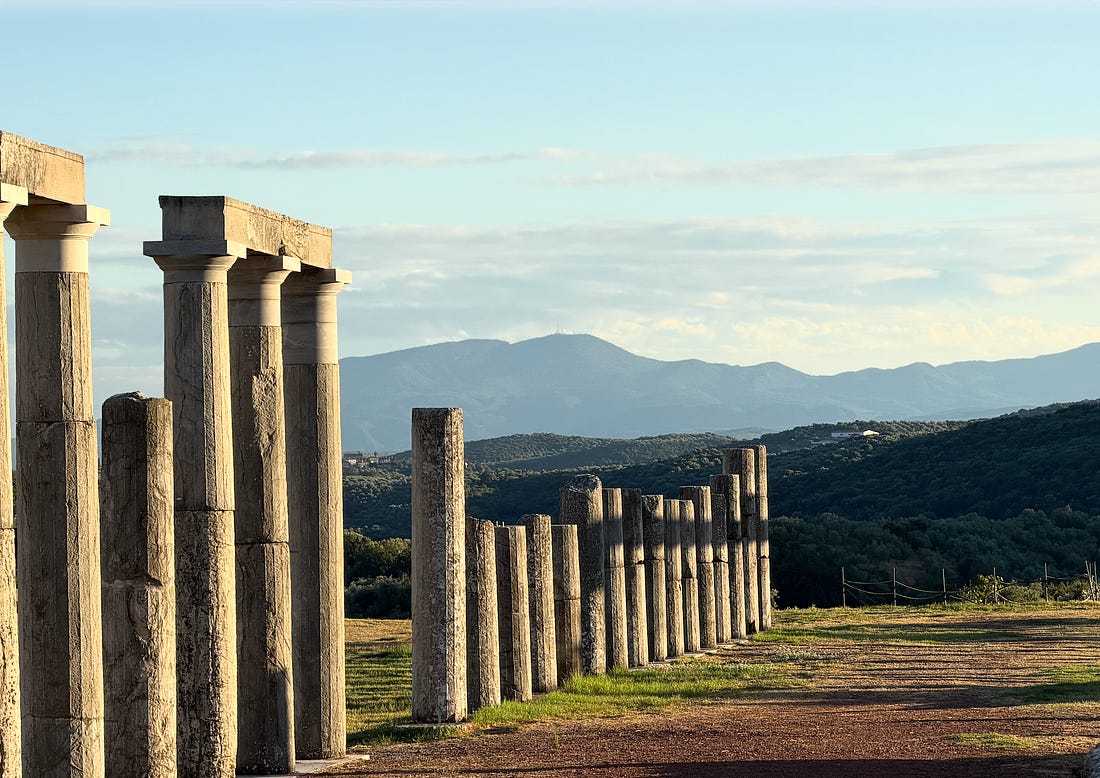
It hit me how unimaginable it would be to have a ‘hundred year war’ in our day and age. We can’t believe the conflict in the Middle East has gone on for 8 months. Then listening to Greeks casually talk about hundreds of years of war, you wonder if our perspective of what is possible is highly influenced by an 80 year period of relative calm. Are we more intelligent and civilised now, so long wars don’t happen any more? The recent track record is that they don’t, Or can big, nasty multi-year, even multi-decade wars still happen? As they have in the past.
Do drones and robots and precision missiles make it more likely that we have lower intensity, but longer lasting wars because fewer human casualties are involved?
Maybe the current conflict gets resolved in December after the mid-terms. Or maybe in 2028 when a new president is elected. Or maybe it goes on to 2030. Or 2130. It’s hard to know. But we have to accept the off-ramps are hard to see right now. Which is why I titled this Hormuz 2030. And the risk is the title looks really foolish next week. But the idea is to expand our imagination on where this could be going and how long it could last.
$200 Oil
There is another reason investors don’t discuss the rise in oil prices, besides that the fact that it’s touchy to talk about the Middle East.
It’s because most are structurally bearish.
Oil is a dirty boomer fuel. A relic of the past. It will be like whale oil. Autonomous cars and robots don’t run on Brent Crude.
The bearish view is oil would be $65 if it weren’t for the conflict with Iran. “You oil bulls got your dream event, a war in the Middle East and oil still can’t stay consistently above $100/barrel. That tells you how broken it is. It’s in a structural bear market” The futures curve confirms this with 2030 oil futures at $65 and 2037 at $55. The futures market says the outlook for oil is slow death.
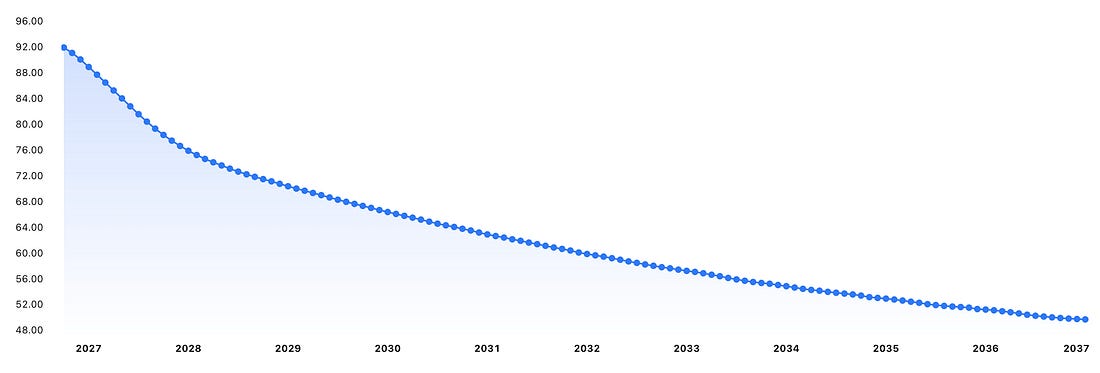 WTI Futures Curve
At this point there are two rebuttals I might make to the oil bears
You were saying all the same things at $65/barrel and are saying them again at $95…..so….
As for not holding $100 despite all the conflict… let’s give it time. We’ve had an unprecedented draw down of global inventories to keep oil below $100. But that is a short-term solution. And it’s really ironic, or predictable, that Biden reduced the SPR a few years before we got the exact event it was created decades ago to cushion. Either this conflict ends soon or we are going much higher.
But I’m not going to say any of that.
Because I want to make a different point.
This isn’t all about supply. There is a demand side too.
We focus on the EV’s and renewables in developed markets, but we never step back and appreciate the hundreds of millions of emerging consumers entering the market place who need a lot of energy and are probably not going to plug an EV into their unreliable electricity grid. I agree EV’s are a headwind to oil price, but possibly we have the relative magnitudes wrong.
Do you remember the last commodity boom which started in 2002 and why it happened?
It kicked off because 1 billion Chinese started consuming while the mining and energy industry didn’t see it coming and wasn’t ready for it. So prices squeezed higher for years before supply could react.
Well guess what? 1.3 billion Indians just did the same thing. GDP per capita in India has been going vertical and has crossed $2,500. In today’s $’s this is that same inflection point China hit in 2002. And like last time nobody is ready for it or talking about it.
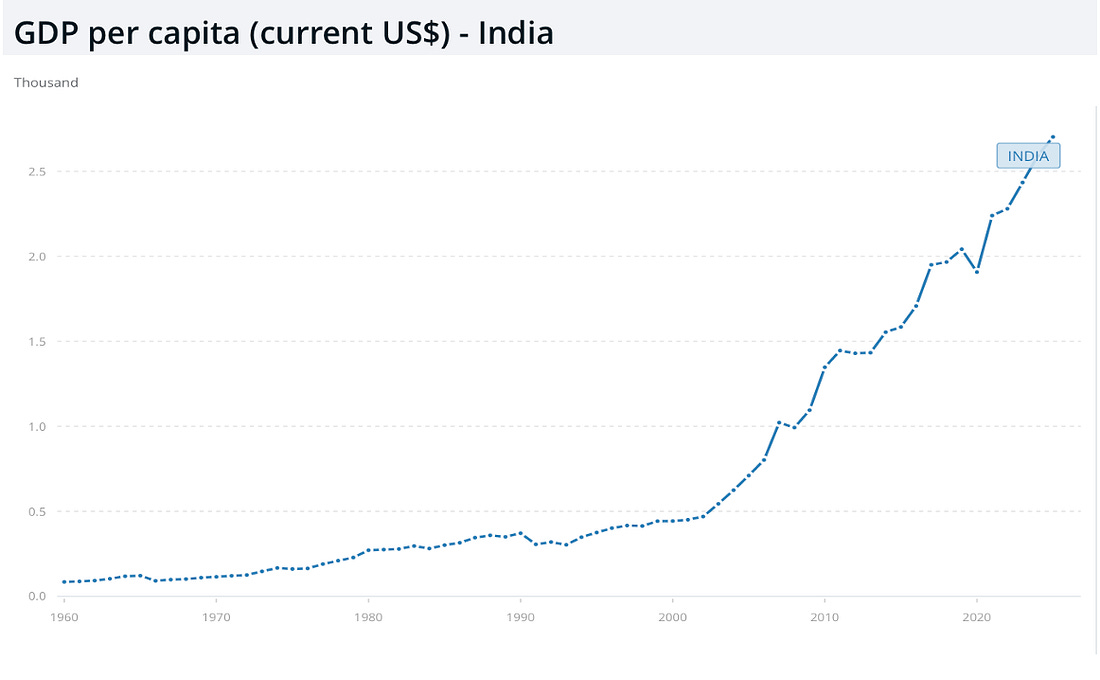
We are all focused on EV’s and the weak Chinese economy, but nobody is talking about 1.3 billion Indians. Or for that matter 1.4 billion Africans.
For years the IEA did an amazing job of brainwashing the world that hydrocarbon demand was going to decline, not grow through 2050. And everyone bought into it. The energy industry, particularly the European oil majors, set modest targets for production growth. They reduced exploration, reduced drilling and reduced growth capex. BP, Shell and Total shifted a portion of their capex budget to renewables and away from hydrocarbons.
This bullish EM demand story which the industry doesn’t see coming is why I was pitching $200 oil last year before the Middle East problems even started.
Link to: Why $200 Oil Pops the Bubble.
Where do we go from here?
I’m going to take a stab at how this plays out across asset classes.
It’s hard to do, but I think you have to. And maybe it helps.
Sometimes it helps to have a guy like me plant a crazy idea out there that we could have a multi-year energy crisis unfolding. Then you can discuss it objectively at your IC’s without the reputational risk of being the one who came up with the idea if everyone thinks it’s ridiculous.
Also this is not financial advice and has a high chance of being wrong.
Oil Prices
I’m sounding the alarm because from here on out if this doesn’t get resolved energy prices are going to start to bite. China and the US have done a lot to alleviate the problem so far by running down inventories. If the problem persists for months (or years) the world will have to adjust to the actual run rate of available oil. Prices will move higher. The next move up will be to $120-130 (in the paper market). I know we are already there in the physical market.
While $130 crude oil prices (in the futures market) will be increasingly painful, my unscientific view is this will not crash the global economy, even considering record refining margins on top.
Energy as a share of GDP/capita has been declining for the G7. 20% higher energy prices sounds negative, but it’s become a smaller and smaller slice of the consumption basket. Another $50/month at the pump isn’t fun, but things don’t grind to a halt. It also takes time for energy prices to filter into slower moving prices such as rent and mortgage payments. It’s why it’s going to take a substantial move in oil prices, like a move to $200, in order to derail things.
Another reassuring sign for global growth is that so far emerging market currencies and inflation have been surprisingly well behaved. The EM’s have been managing the energy crisis well up to this point.
Relationship between Demand and Price
A word on high prices killing energy demand, because that’s a common view. Oil prices won’t go higher and could actually fall because higher oil prices will kill demand. Oil price may go up, but then they will go down.
An economist would say a supply shock, which is what we are experiencing, shifts the supply curve to the left. After the shock there is a lower quantity (Q) of oil available at every price point (P) compared with before. This shift creates a new equilibrium point where the demand (line going top left to bottom right) and supply (lines going bottom left to top right) intersect. This new equilibrium point has both lower quantity and higher prices compared with before the shift. Which fits what we see currently. Yes, there is less oil available for consumption, demand has been ‘killed’, but with higher prices.
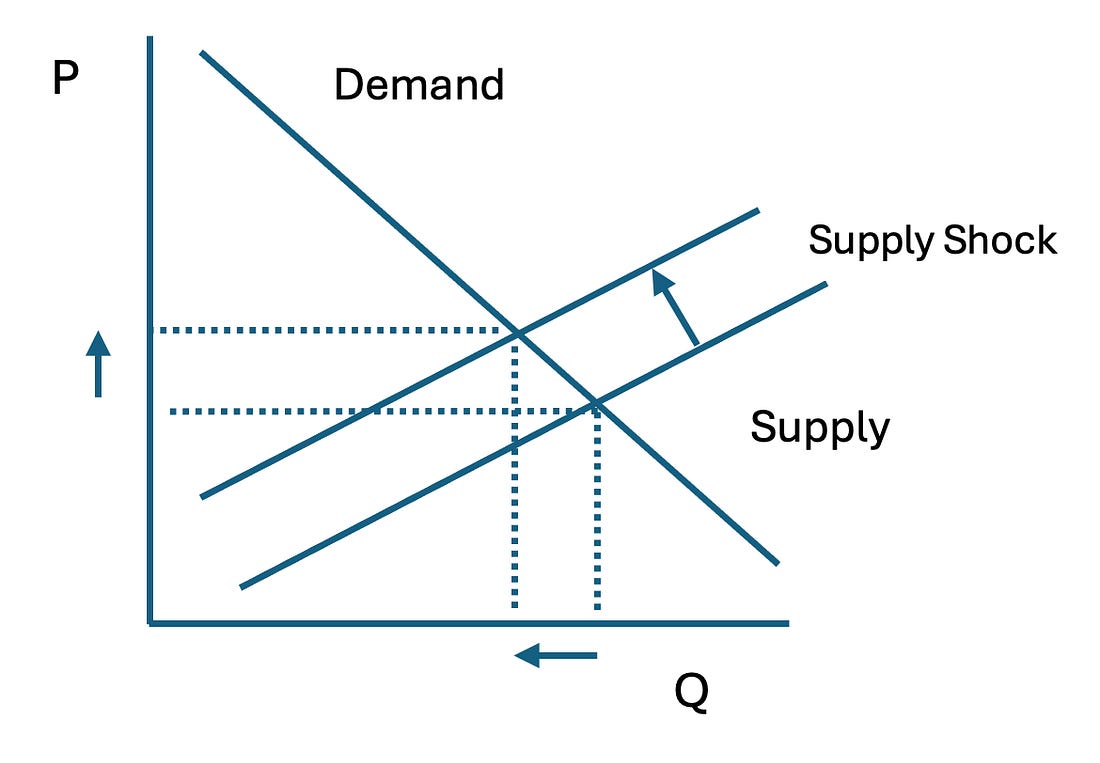
The real-life picture can get more complicated than this 1 stage Supply-Demand model. Where the bears can be right is if central banks decide they want to fix high oil prices by raising interest rates. Then the Demand Curve shifts left and the new equilibrium point is further to the left. Meaning even less quantity. Depending on the relative slopes of the demand and supply curves prices end up lower than after the shock, but maybe still higher than before the shock.
The Energy Crisis is a tricky one for the central banks. It puts them in a difficult position. Same as with Covid. It’s a supply shock, not an overheating economy. And central banks realise they should not be making matters worse trying to fix a supply shock with higher interest rates. But then on the other hand the inflation readings are out of hand and they feel they need to do something.
US Equities and S&P $10,000
Like I said above. I don’t see $130 oil crashing the world economy or the US economy. I think US stocks can still go higher, for now.