

Note to readers: This company feature reflects the research we conduct at
, an independent boutique investment manager focused on identifying wealth-creating smaller companies. Today, we examine BioSyent, a Canadian specialty pharmaceutical company whose expansion into oral health and endocrinology has opened several new avenues for growth. This is NOT investment advice, please read the disclaimer at the end.
RX-TSXV, $14.50 - $167 million Market Cap
BioSyent is a Canadian specialty pharmaceutical company that sources, in-licenses and commercializes niche healthcare products, and which recently diversified into oral health through the acquisition of Oral Science.
 A New Dose of Growth | Canva
Company Overview
BioSyent does not discover drugs. It licenses them, which means the business carries no research risk and no patent cliff, and turns almost entirely on commercial execution. Through its BioSyent Pharma subsidiary, the company identifies underserved therapeutic niches, in-licenses or acquires products with genuine clinical differentiation, and commercializes them through a small, focused Canadian sales force. The formula has now produced 63 consecutive profitable quarters.
The business has historically rested on a single pillar. FeraMAX has been Canada’s leading recommended iron supplement for the eleventh consecutive year, and until recently it accounted for roughly 70% of revenue. That concentration has changed materially over the past 18 months. BioSyent has launched Thyconvi, a new liquid endocrinology product, and in March 2026 closed its largest acquisition to date, paying $25.5 million for Oral Science, a Canadian dental hygiene distributor. FeraMAX now represents closer to 40% of revenue. This is a more diversified and more resilient business than it was even two years ago.
History
BioSyent traces its roots to Hedley Technologies, a legacy biological insecticide business that still contributes modest and lumpy revenue today. The company renamed itself BioSyent in 2006 to reflect its pivot toward pharmaceuticals, and has since built a business focused largely on women’s health, selling into pharmacies, hospitals and specialists, primarily in Canada.
In September 2024, BioSyent paid roughly $4.4 million for global distribution rights to Tibella and Tibelia (tibolone), a hormone replacement therapy already growing at more than 30% annually in Canada. Three months earlier, it had signed a licence agreement for a European-partnered endocrinology asset at an upfront fee of just EUR 50,000. That asset has since become Thyconvi. Management has described it as one of the company’s most asymmetric bets, with negligible capital at risk against a product addressing hypothyroidism, one of Canada’s largest chronic prescription categories.
With Oral Science acquired in March 2026 and Health Canada approval of Thyconvi granted in May 2026, the company has added oral care and endocrinology as genuine new avenues for growth.
What They Do
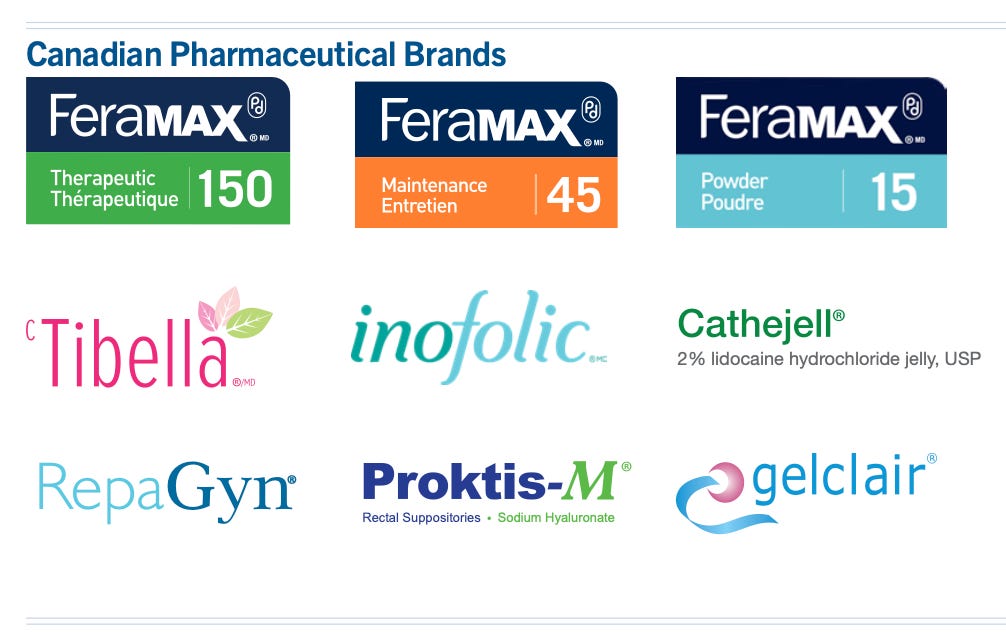
Pharmaceutical sales, Canadian and international. FeraMAX remains the core, alongside Tibella in Canadian hormone replacement therapy and Tibelia in international distribution, plus a handful of smaller specialty and community health brands. This segment generated $40.9 million of sales in 2025, or 95% of the total.
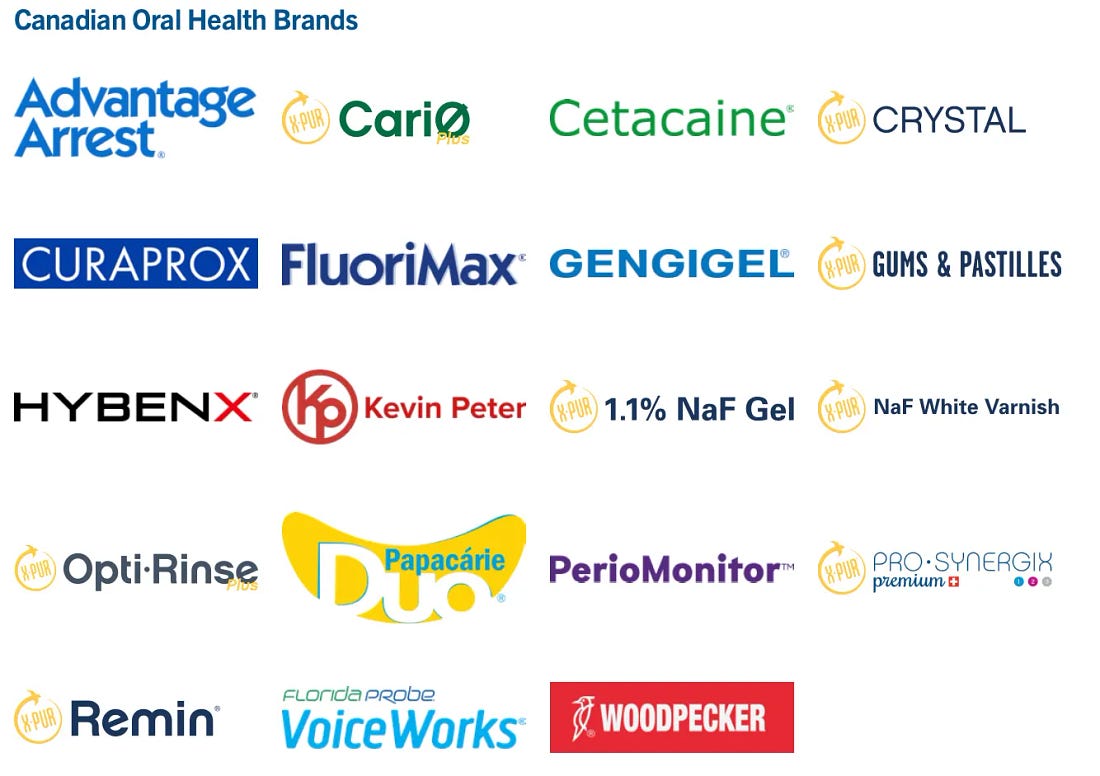
Oral health. Oral Science distributes dental hygiene products into more than 6,000 Canadian dental clinics, close to 40% of the clinics in the country, as well as through retail pharmacy and direct-to-consumer channels. Roughly a third of its revenue comes from proprietary products and the balance from exclusive distribution agreements with international partners. Oral Science generated approximately $31.2 million of revenue in 2025 and has compounded at 15% historically.
Thyconvi. A newly launched oral liquid formulation of levothyroxine, the standard treatment for hypothyroidism. Levothyroxine tablets have been available generically for decades, but no liquid alternative has existed in Canada. That is a real gap for patients with swallowing difficulties, for paediatric patients, and for anyone whose absorption issues make consistent tablet dosing unreliable.
Legacy business. A small, non-core insecticide operation that we treat as a residual cash flow stream.
Investment Case
Oral Science is a bigger near-term catalyst than the market has recognized
This may be the most underappreciated part of the current setup. Reported results to date include only a single month of Oral Science, namely $2.98 million of revenue in March 2026. Investors have not yet seen a full quarter inside BioSyent’s numbers, let alone a full year.
Management has guided to roughly $30 million of Oral Science revenue over the ten months of 2026 ownership, and our base case assumes 10% to 12% organic growth over the next several years. That growth should come from continued penetration of categories such as air polishers, which remain early in their adoption curve in Canadian clinics, alongside a broader push into dental service organizations. BioSyent paid 6.3 times trailing twelve-month EBITDA, and less than five times after adjusting for working capital, a highly accretive multiple for a quality business growing at double digits.
Thyconvi is conservatively underwritten
Thyconvi has cleared Health Canada and moved into commercial launch, and BioSyent is now filing for private insurance reimbursement on a wide-open label. Notably, management’s base business case assumes no contribution at all from provincial reimbursement, on the view that the discount required to win formulary listing would be too steep to be economically attractive. The plan is built entirely around the private-pay opportunity.
Management has guided to a $10 million peak-year sales target and cautions that reaching it could take more than five years. Our own work, cross-referencing IQVIA prescribing data against international liquid levothyroxine analogues, points to a wider plausible range of $5 million to $20 million. The core target populations are underserved today: patients with swallowing difficulties, who represent roughly 2.5% of the population and a larger group than most investors would guess, patients with fluctuating thyroid-stimulating hormone, and paediatric patients. We do not believe the market is giving BioSyent any credit for what Thyconvi can contribute over the next three to five years.
Capital allocation is disciplined and shareholder-friendly
BioSyent continues to raise its dividend and repurchase stock even while absorbing the Oral Science acquisition. With the balance sheet already building cash after the deal, management has signalled an acquisition opportunity set that now spans oral health and additional endocrinology assets alongside the traditional pharmaceutical base.
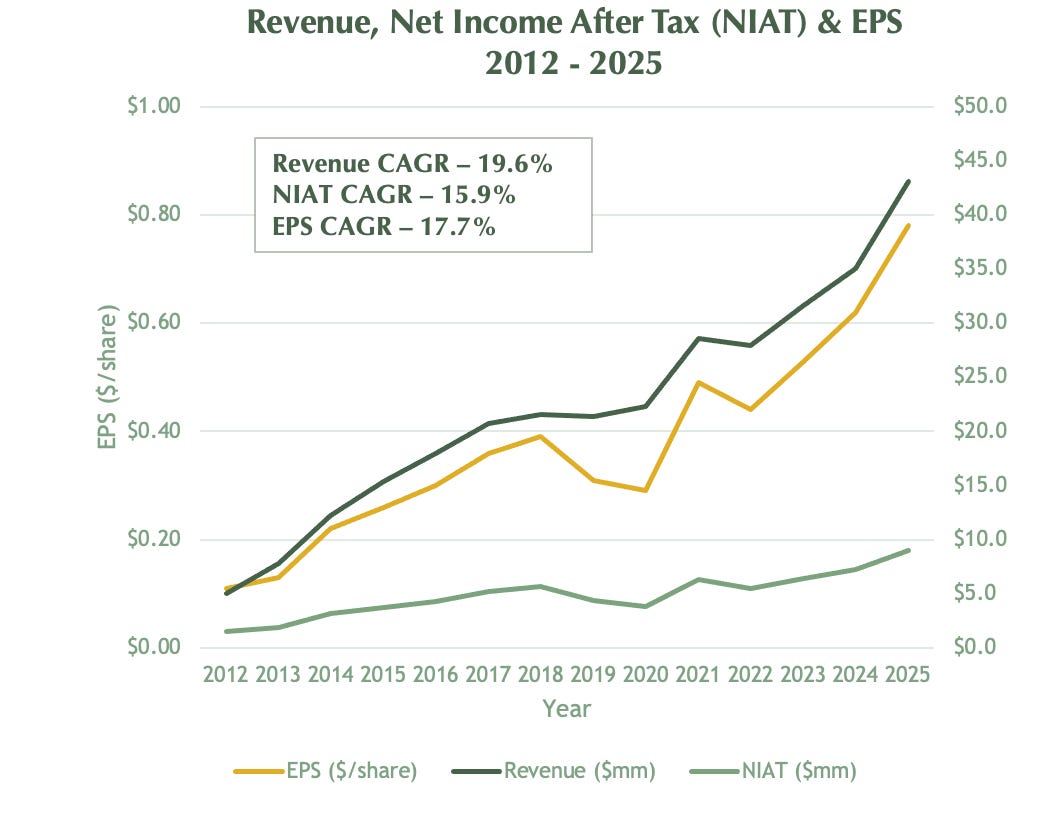
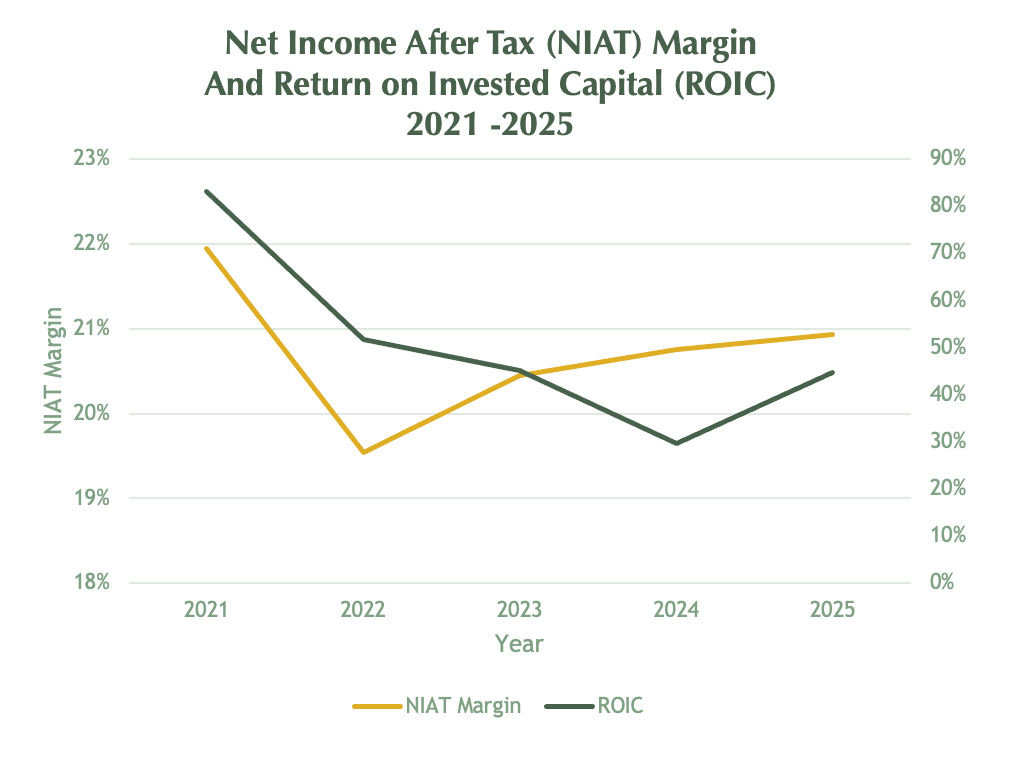
The track record supports the confidence. Over the past 14 years, revenue has compounded at 19.6%, net income after tax at 15.9% and earnings per share at 17.7%, all while the share count has fallen by 20%. Operating margins remain strong and return on invested capital is impressive. President and Chief Executive Officer René Goehrum owns roughly 20% of the shares. We think that alignment is a large part of why capital allocation has been this disciplined.
Optionality
PerioMonitor. Oral Science has developed a chairside gingivitis diagnostic that delivers results in minutes at a fraction of the cost of the lab-based swab-and-send alternative. The product has already secured approval in the United States, and management has confirmed it is actively seeking to out-license the product for markets outside Canada. The potential is genuinely hard to size today, which is precisely why Oral Science structured the sale to BioSyent to include a royalty on it. We understand the royalty is capped, and that margins remain very strong even after royalty payments. We would not be surprised to see a global out-licensing deal announced with a multinational partner within the next twelve months.
Thyconvi beyond the base case. Because the business case assumes no public reimbursement, any provincial formulary access is pure upside. So is any outcome toward the higher end of our $5 million to $20 million range.
Further acquisitions. Balance sheet capacity and management’s stated interest across both oral health and endocrinology make another acquisition plausible over our investment horizon, though we do not build one into our base case.
FeraMAX pipeline. Additional line extensions remain in development, including what we believe is an iron combination product, a natural extension of the existing women’s health franchise.
Risks
Accrufer competition. Accrufer (ferric maltol), launched by Kye Pharmaceuticals in early 2025, is the first and only prescription oral iron product in Canada. Prescription status is a structural advantage over FeraMAX’s classification as a natural health product, because it opens the door to provincial formulary and drug plan coverage that FeraMAX cannot access. Accrufer is off to a strong start and has built a real commercial base — enough to matter against a franchise the size of FeraMAX, though still a small fraction of it. FeraMAX continued to grow through 2025, and the evidence to date suggests Accrufer is drawing new patients rather than switchers. The overall iron market is expanding. Even so, this remains the single largest watch-point for our thesis.
Thyconvi execution. Reimbursement filings, physician adoption curves and peak sales timing are all unproven. Our $5 million to $20 million range is wide for a reason.
Oral Science integration and distribution dependency. This is a newly acquired business with its own key-person considerations around founder Daniel Ménard, and with distribution partner concentration. That includes its relationship with Curaden, which is working through a leadership transition following the death of its founder in mid-2025.
Liquidity and information asymmetry. BioSyent has coverage from a single sell-side analyst and thin average daily dollar volume. This cuts both ways. It is part of why we believe the opportunity exists at all, but it also means the shares can move sharply on light news flow, and that building or exiting a position of size requires patience.
Valuation
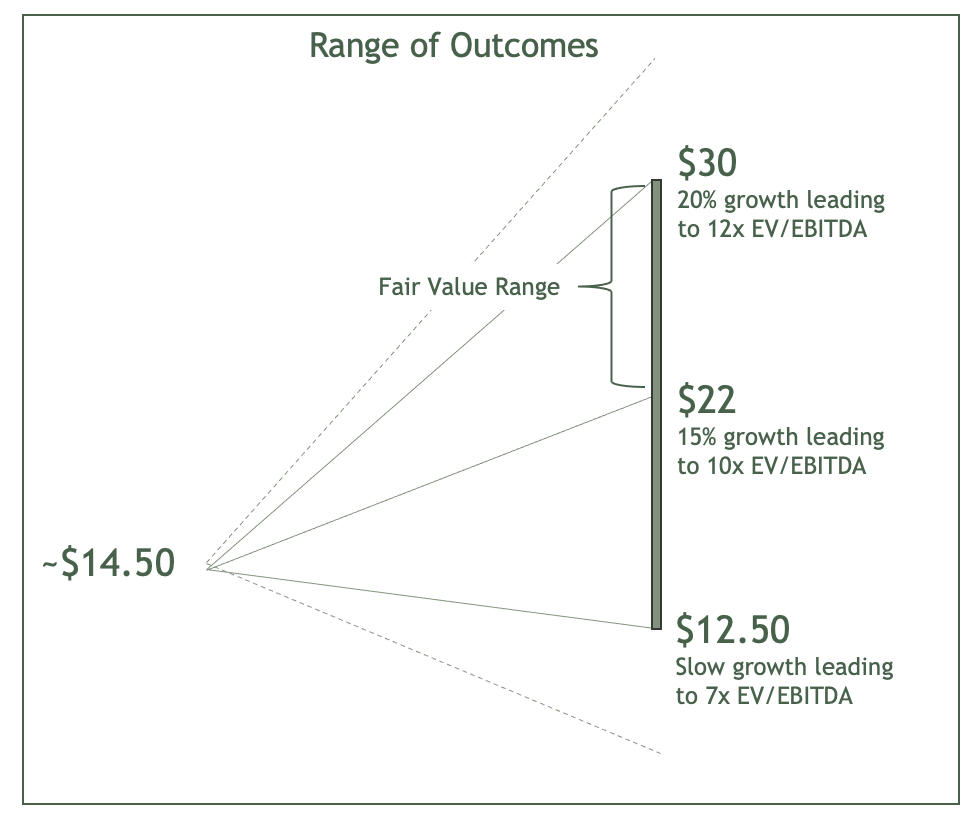
BioSyent trades at roughly 8.5 times our 2027 estimated EV/EBITDA, which we find attractive. Our base case has earnings per share compounding at 18% from 2025 to 2028 and adjusted EBITDA at 24% over the same period, with most of the increase coming from the addition of Oral Science.
Those figures rest on mid-single-digit growth in pharmaceutical sales, a modest contribution from Thyconvi in 2027 and 2028, and 12% growth in oral health. This requires strong execution, but it does not require anything exceptional. If the company delivers, we believe the business should be valued at 10 to 12 times EV/EBITDA.
The chart below shows how we think about the asymmetry. Our base case produces a fair value range of $22 to $30 per share depending on the growth rate and the multiple applied. The range is wide because it looks out three years, but the asymmetry is compelling given our view of the limited downside. Outsized success with Thyconvi, PerioMonitor or a further acquisition could push the outcome beyond the top end.
Final Thoughts
BioSyent is an owner-operator small cap with a strong record of capital allocation and operational execution. The market was not paying much attention to it while the story depended so heavily on FeraMAX, and we were in that camp for some time despite having the company on our watchlist. What the market is missing now is that this is no longer a one-trick pony. It has diversified, and the drivers of growth and the sources of optionality have both expanded.
The investment case will not play out in the short term. That is fine by us. We are content to be aligned with a management team that has meaningful skin in the game and a long record of creating value. An investor who bought BioSyent when René Goehrum took the helm in 1999 at roughly $0.20 per share would have made more than 72 times their money.
We believe a new era is beginning. This management team now has more ways to win across a larger portfolio. Oral Science is the company’s largest acquisition and arrives with a strong growth trajectory. Thyconvi is its highest-potential in-licensed prescription product to date. Neither is appreciated in the market today. Understanding all the moving parts of a larger business takes time, but we expect the results will eventually be hard to ignore.
We also like the resilience of the model. Whatever happens with international conflict, the oil price, inflation, consumer credit and trade wars, a business like BioSyent is largely insulated. The success driver here is execution, an area where this management team has a long and profitable track record.
Disclaimer
This newsletter and any related emails (the “Publication”) are provided for informational and educational purposes only. They do not constitute an offer, solicitation, or recommendation to buy, sell, or hold any security or other financial instrument, nor should they be interpreted as legal, tax, accounting, or investment advice. The Publication is general in nature and has been prepared without regard to the investment objectives, financial situation, or particular needs of any specific person. You should conduct your own independent research and consult with a qualified financial adviser and other professional advisers before making any investment decision. The information contained in the Publication is based on sources believed to be reliable, but its accuracy, completeness, or timeliness cannot be guaranteed. All information and opinions are subject to change without notice. Any forward looking statements or projections are inherently uncertain and actual results may differ materially due to various risks and uncertainties. Investing involves significant risks, including the possible loss of principal. Past performance is not indicative of, and does not guarantee, future results. The author(s) and related parties may hold or acquire positions in securities, instruments, or issuers discussed and may buy or sell such positions at any time without notice. Neither the author(s) nor any publisher, affiliate, director, officer, employee, or agent accepts any liability for any direct, indirect, incidental, consequential, or punitive damages arising out of the use of, or reliance on, the Publication. Jurisdictional and regulatory notices United Kingdom: This Publication is general editorial content. It is not an invitation or inducement to engage in investment activity for the purposes of section 21 of the UK Financial Services and Markets Act 2000. If you choose to engage in any investment activity, you should rely only on the terms of the relevant offer as set out in the issuer’s prospectus and applicable regulatory filings. European Economic Area, North America, Australia, and Asia: Distribution of this Publication may be restricted by local law or regulation. It is not intended for any person in any jurisdiction where such distribution would be contrary to local law or regulation. Recipients are responsible for informing themselves about, and observing, any such restrictions that apply in their jurisdiction. By reading the Publication, you agree that you use it at your own risk and that you are solely responsible for any investment decisions you make.
Positions and Conflicts of Interest
This article was co-written with Robert Gignac and was originally prepared as a Forterra Investment Management company feature; the “we” throughout refers to Forterra. It is republished here with Forterra’s permission. As of July 31, 2026, Forterra holds shares of BioSyent Inc. (TSXV: RX) in the accounts it manages. Both authors hold shares of BioSyent in their personal accounts. Neither author nor Forterra has been compensated by BioSyent, Oral Science, or any affiliate in connection with this article, and neither has any commercial or advisory relationship with the company. Neither author nor Forterra will transact in BioSyent shares for ten business days following publication. Thereafter each may buy or sell at any time, without notice and without updating this article. Readers should assume any position described here is subject to change. BioSyent is a TSXV microcap. It trades a median of roughly 5,000 shares a day, and some sessions barely trade at all.
A guest post by
Robert Gignac
Insights on small cap investing, markets and commentaries from Robert at Forterra Investment Management.