TonyTheBullSeverino
Private Post
Get access to all contentUnlock private posts and exclusive community discussions.Sign up

Chartered Market Technician. Cycles, crowds, psychology. I don’t predict — I observe structure. Less noise. More signal.

Joined on 15th November 2024

Boston, MA

This is a bullish alt Elliott Wave count that I am now seeing go around. Even I have considered this potential count
From an anticipatory standpoint per EW, it makes sense as a 1-2/1-2 setup and Running Flat correction
However, this would imply an impulsive wave (3) is next
Wave (3) is the longest and strongest in an impulse wave – it must exceed ~600% of wave (1)
That would mean that Bitcoin would need to go to over $550,000 during wave (3) to exceed the price movement of wave (1)
I struggle to see how this happens within the next couple of years
Possible, but an improbable count for that one reason

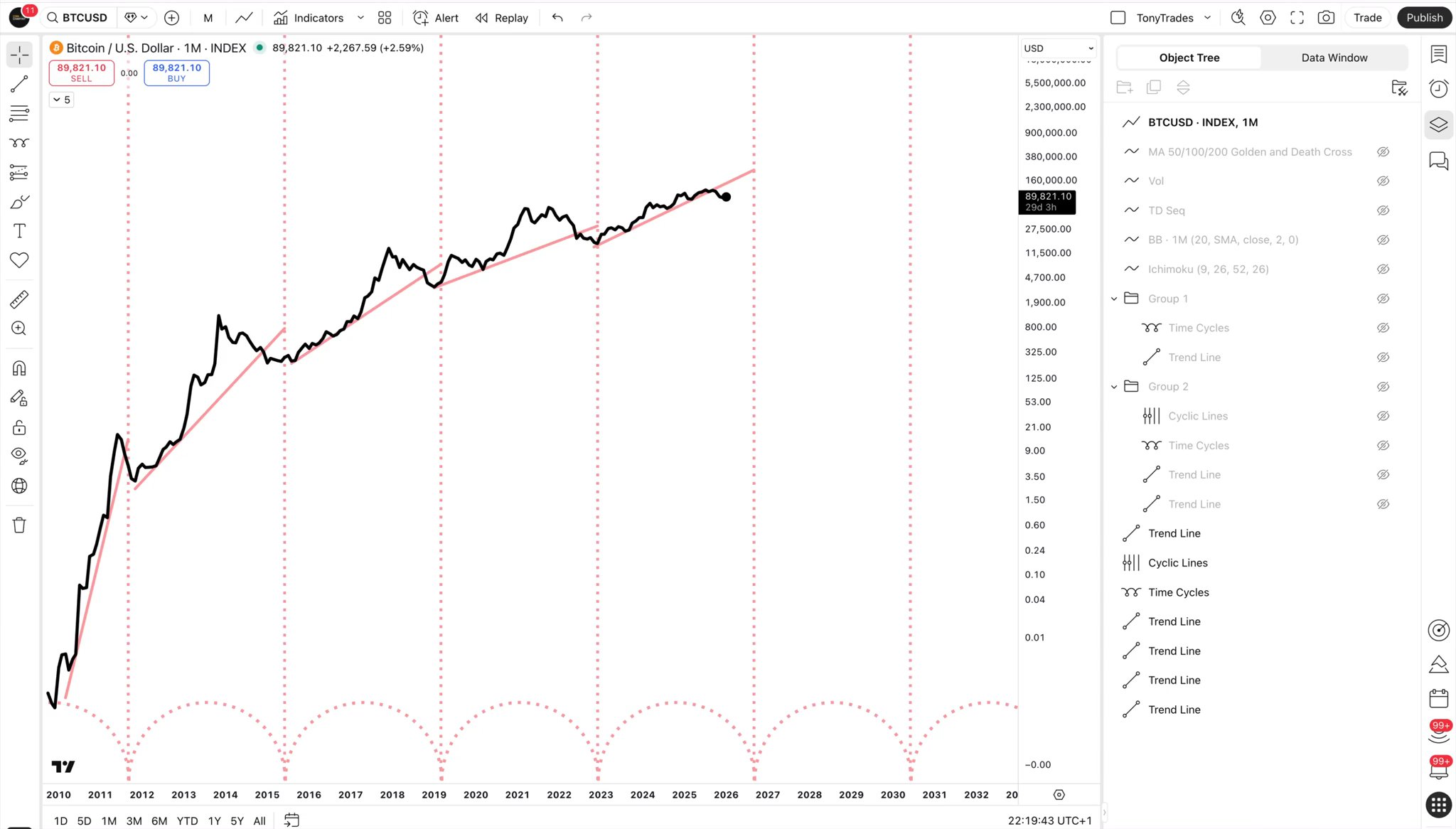
I posted three charts today on X regarding Bitcoin's different cycles across 4-years, 8-years, and 16-years.
This video ties it all together, fully explains Hurst Cycle Theory and how to apply it, and what it applied to Bitcoin might suggest for the cryptocurrency's future.
It also explains the theory's core principles and what to expect as the cycle reaches its amplitude.
Thanks for watching. Feel free to ask any questions.
Hurst Cycle Theory is a revolutionary approach to understanding the financial markets. Developed by J.M. Hurst in the 1960s, it remains a cornerstone of technical analysis. It’s anchored on the premise that markets move in cyclical patterns. These cycles, though seemingly random, carry underlying patterns that a discerning eye can decipher.
The foundation of Hurst Cycle Theory lies in the analysis of these patterns. It uses a complex yet efficient method to reveal the rep